
Recall Notes
-
This is a blog written by a mastering engineer about mastering, but it is not a “how to master” blog. There are other places on the internet for that.
Mastering music has been my full time occupation for over 20 years, and during that time I’ve noticed some of the same ideas and conversations coming up repeatedly. At some point I decided to keep an informal journal of some of these ruminations, sometimes to clarify my thinking about them, and sometimes just because they wouldn’t go away until written down!
Each entry is like a little note-to-self. Things to remember or build upon as the months and years have passed.
And though I didn’t originally intend to make any of these notes public, I decided to share them here because I personally really like reading what other professionals have to say about their craft. So if you’re a mastering engineer or mixer, please write and publish your version of this blog - I would read that!
- J. LaPointe (August 2025)
Three Passes
I find I have about 3 passes of a song before I start trying to fix “problems” that aren’t actually there.
So given my point earlier about first impressions, the sweet spot for making a good master seems to be somewhere between 1-3 passes, and no more.
Things I’d actually like AI to do for me
Download the day’s mixes and load them in sequence in the Pyramix timeline
Scan for clicks, pops, and glitches and place markers where any are found
Automatically run masters of alternate versions and instrumentals based on the settings of the main versions
Export finished masters and upload to the client for approval
Export approved production masters in all formats
Null test or otherwise verify all production masters
There’s probably a bunch more useful tasks I'm forgetting, but you get the idea. Get these repetitive menial jobs done and leave the actual human work to me.
How to make everything in your mix sound bigger instantly
Turn down the cymbals.
Seriously.
The listening public is not nearly as excited about the sound of your overheads as you are.
Don’t Delete
With the low cost / high storage capacity of current hard drives it makes a lot of sense to keep all of your clients’ masters (and working files) forever.
Fill a drive, put it on the shelf, and pop in another.
In my case I have a four bay SSD dock. One drive holds the current work, another clones this drive, and a third is for daily incremental backups. When the current work drive is filled it just goes on the shelf along with it’s clone, with a note marking the start and end dates of the contents.
As a further backup I clone the full working drive to a huge 24TB USB drive. Redundancy is good. For many years I had everything mirrored in an unlimited storage Google account as well, but the Google enshittifiers pulled the plug on that one.
When I need to find an old project I just look back through emails or billing records to quickly find the date a project was mastered, and thus the right drive, without the hassle of maintaining a formal drive directory listing.
I don’t advertise or charge for this, as I don’t want the potential legal ramifications of running an archiving service, but if anyone asks I just tell them the files will be here until the hard drives fail (which they will eventually, but so far so good), and encourage them to keep their own copies and backups too.
Countless times I have been able to provide replacement files after all manner of tragedies, including stolen computers, hard drive crashes, even house fires.
The goodwill this generates can only be good for business.
High Fidelity versus Listenability
What makes for the most hi-fi master may not make for the most listenable master.
More Minimal
Try:
- balancing a whole album with only gain changes first (then fill in the gaps with eq)
- finding the one perfectly placed broad band of bell eq that brings the whole track into focus
- giving yourself one pass to nail the next track
The broader the adjustment, the wider the translation
One of the goals in mastering is to make adjustments that translate into improvements in the sound of the master across a wide range of playback situations - everything from big stereos to small stereos to computer speakers to headphones to cars to …
The broader the adjustments, the more likely it will be heard as intended in the widest variety of playback situations.
For example, a 1db change in overall volume sounds like a 1db change pretty much everywhere. Similarly, eqing with very broad shelves translates into tonal changes that sound consistent across many different speakers.
On the other hand, very specific adjustments like narrow eq tweaks are much less likely to be heard as intended on a wide range of speakers. The narrower the tweak, the more likely it will only be an improvement in your room. Out in the real world it may sound better on some systems, be mostly inaudible on others, or even sound worse than the source.
Before getting surgical better be damn sure you are fixing a problem in the recording and not a problem in the monitoring.
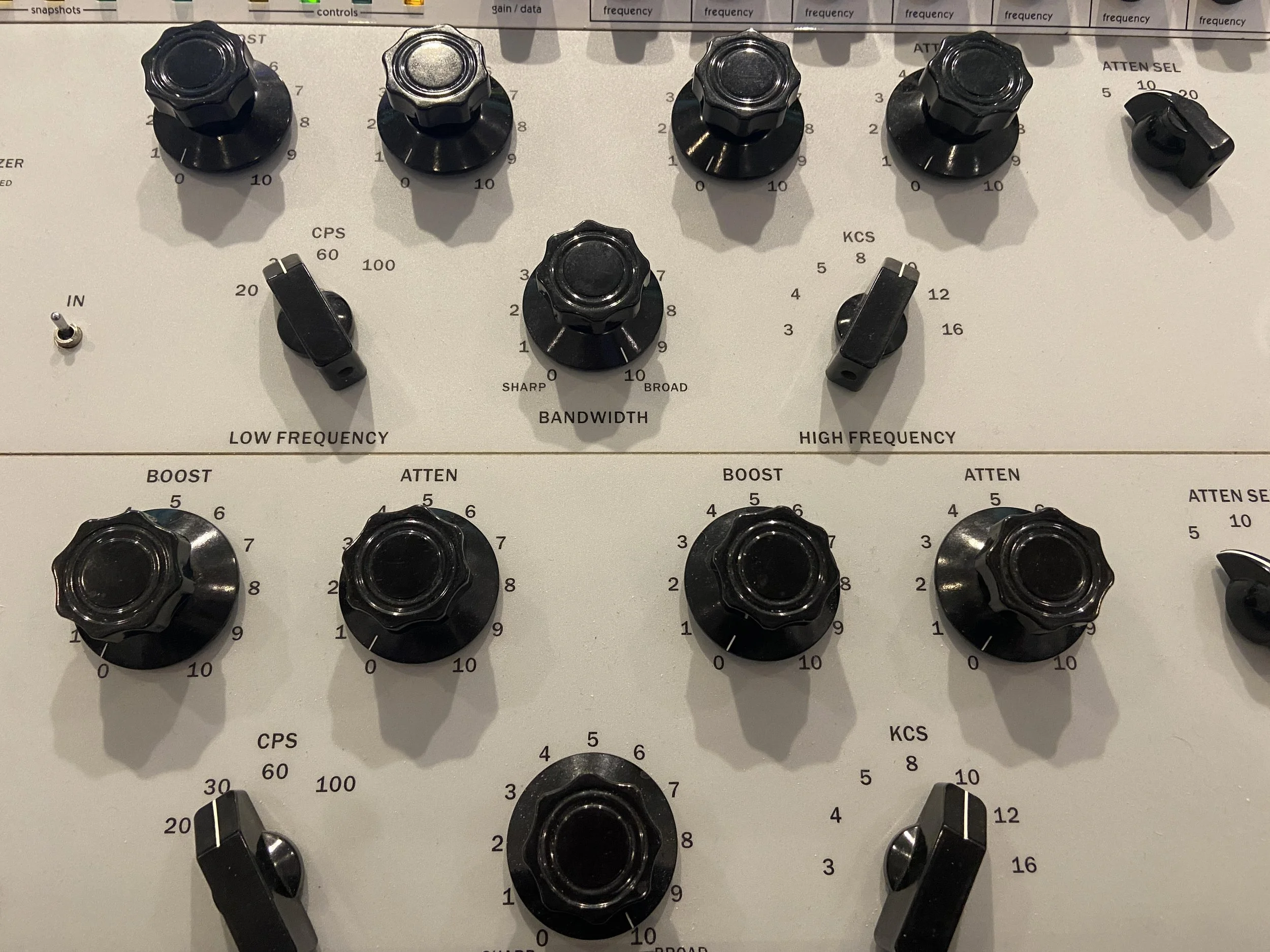
Evaluating mastering equalizers
1. Can it correct broadly unbalanced tracks swiftly and intuitively? Many EQs qualify.
2. Perhaps more importantly, can it get in and fix the one small (but critical) problem in an otherwise perfect mix without creating other problems? Very few EQs qualify.
A little or a lot
Sometimes you can get away with just raising the level.
And sometimes you have to do a ton of processing just to make it sound like you did nothing but raise the level.
Loudspeakers and the Tolerance Parameter
I’ve been using the term tolerance to describe speakers ever since I started using the excellent ATC SCM150s in the mastering room.
What is tolerance as it applies to speakers? Well first of all, it’s a bullshit term that I made up, but basically it’s a way of describing how quickly a speaker will show you when you’ve made a counterproductive processing move. So tolerant speakers have a wide window of acceptable sound, whereas intolerant speakers have a narrower range of acceptable sound.
For example, I have used (well regarded) speakers that would allow you to boost 3db at 4k on a given recording and sound fine. Boosting that same recording 3db at 4k on the ATCs would immediately sound harsh. On the ATCs a boost of 1.5db was more appropriate.
So what is correct?
Checking those two options on a variety of systems in the real world reveals that on most systems, both masters sound very similar, and the 1.5db difference at 4k is mostly a moot point. However, a few systems already predisposed to sounding harsh in the midrange revealed the 3db boost to be too much, and the 1.5db boost to be spot-on. But critically, the opposite was not true - on systems with recessed midrange the 1.5db version was still good. The conclusion here is that the lower tolerance (intolerance) of the ATCs allow the user to spot potential translation problems that would be overlooked on the other mastering speaker system.
To make matters more complicated, tolerance can vary by frequency - for example, some speakers may be tolerant to changes in the low end but intolerant in the highs.
All of this points toward the need to evaluate mastering speaker candidates for an extended period of time, and by doing real work with them.
Just listening to speakers is not enough and won’t reveal their suitability (or not) for making mastering processing decisions.